
Following the Messi versus Cristiano Ronaldo rivalry has also pulled plenty of fans into another world: sports betting. Beyond simply picking who wins a match, football betting comes in several different forms, each built around a different kind of prediction, with its own timeframe and level of risk.
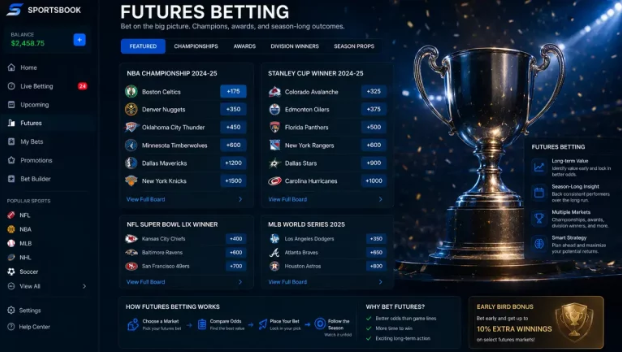
One type doesn’t depend on a single match at all: the future bet. Instead of predicting what happens in one fixture, a future bet is placed on an outcome that won’t be known for weeks or months, such as who wins a league title, an international tournament, or an individual award at the end of the season. It’s exactly the kind of bet that fits a debate like Messi versus Ronaldo, since that comparison is never settled in ninety minutes but across an entire career: who ends up with more trophies, more goals, or more individual honors are questions only time can answer. Anyone who wants to go deeper can discover what a future bet is and see how these longer-term wagers actually work.
The most familiar type, by contrast, settles the same day: the match winner bet, where the only decision is which side takes the win or whether the game ends in a draw. Sitting alongside it is the over/under bet, where instead of picking a winner, the bettor predicts whether the total number of goals in the match will land above or below a number set in advance. Both are usually the first bet type anyone tries, since neither requires deep knowledge of either squad’s current form.
A step further along is handicap betting, built for matches where one team is a clear favorite. Rather than betting on that team to win outright, the favorite is given a simulated disadvantage, for example starting the match a goal down on paper, so the bet only pays out if the favorite overcomes that added handicap. It’s a way of finding more balanced odds in matches where the result already looks like a foregone conclusion, which is why it shows up often in fixtures between a title contender and a team near the bottom of the table.
There are also combined bets, sometimes called accumulators, which stack several separate predictions into a single wager. Every prediction in the combination has to land for the bet to pay out, which lowers the odds of winning but multiplies the potential payout. It’s a common choice for anyone following several matches on the same day who wants to back multiple predictions at once instead of placing them one by one.
Each of these bet types answers a different question: who wins today, how many goals there will be, who has the real edge once the odds are adjusted, or who ends up on top months down the line. Understanding that difference is what lets a bettor pick the wager that actually matches what they’re trying to predict, instead of always defaulting to the simplest option on the board, whether that means a single match, a season-long chase, or a whole career’s worth of records.